Scaling Your Product After MVP: What Founders Should Prioritize Next
Published on June 8, 2026
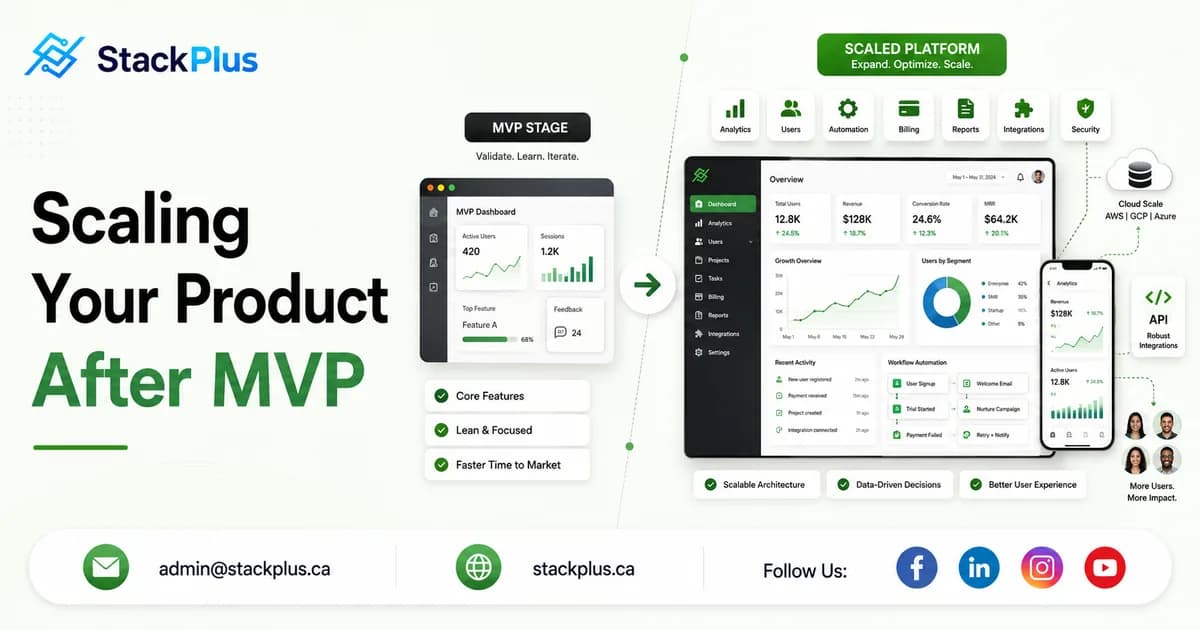
Shipping an MVP feels like a major milestone, and it is. But the hardest product decisions often come after launch, when real users expose what works, what breaks, and what your team assumed incorrectly. Scaling is not about adding every feature request. It is about strengthening the foundation while doubling down on what creates value.
We see this pattern across startups in logistics, healthcare, fintech, on-demand services, and B2B SaaS. The teams that scale well treat the MVP as a learning engine, not a fragile prototype they are afraid to change.
Table of Contents
What scaling actually means after MVP
Scaling does not always mean more users on day one. It means your product can handle growth without breaking trust. That includes performance under load, clearer onboarding, better data visibility, stronger security, and a roadmap tied to business outcomes instead of random feature ideas.
- Reliability: fewer bugs, faster recovery, and clearer monitoring
- Usability: smoother flows based on how people actually use the product
- Operations: less manual work for your internal team
- Architecture: code and infrastructure that can grow with demand
- Focus: saying no to features that do not move key metrics
Read the signals from your first users
Before you expand scope, study what your earliest users are telling you through behavior, not just feedback forms. Where do they drop off? Which actions do they repeat? Which workarounds are they inventing because the product does not fully support their job yet?
The best post-MVP roadmap comes from patterns. If five pilot customers all export data manually, that is a product signal. If support requests cluster around one confusing step, fix that before building a new module. Scaling starts with removing friction in the core workflow.
Prioritize the next release in this order
Founders often feel pressure to launch mobile apps, admin dashboards, billing systems, and integrations all at once. That spreads engineering thin and slows learning. A healthier sequence looks like this:
- Stabilize: fix critical bugs, improve performance, and tighten auth or permissions
- Clarify: improve onboarding, empty states, and the primary user journey
- Automate: remove manual steps your team is doing behind the scenes
- Extend: add the next feature that unlocks revenue or retention
- Expand: new platforms, integrations, or user roles once the core loop is strong
This order keeps the product dependable while making each new investment easier to justify with data.
Avoid the rebuild trap too early
Many teams assume they need a full rewrite once the MVP succeeds. That is rarely true at the first sign of traction. Rewrites are expensive, slow, and often delay the improvements users are waiting for.
Instead, refactor the parts that hurt most: brittle modules, slow queries, unclear domain logic, or missing tests around critical flows. Incremental improvement lets you keep shipping while gradually improving the foundation.
When to invest in mobile, AI, and integrations
These capabilities can create real leverage, but timing matters. Mobile makes sense when users need access in the field or on the go. AI makes sense when it removes meaningful manual work with acceptable accuracy. Integrations matter when data silos are blocking operations or sales.
- Mobile: prioritize when usage patterns show strong mobile intent or field workflows
- AI: add when you have enough data and a clear human-review process
- Integrations: build when manual syncing is slowing growth or causing errors
- Analytics: invest early so every release can be measured against outcomes
Build the team model that matches your stage
Post-MVP growth often outpaces a small internal team. That is when founders consider contractors, agencies, or dedicated developers. The right model depends on roadmap length, technical complexity, and how much product knowledge needs to stay in-house.
Dedicated developers can work well when you need steady velocity, deep codebase familiarity, and flexible capacity without hiring full-time too early. The key is alignment on priorities, communication rhythm, and ownership of outcomes, not just hours logged.
How StackPlus helps products scale after launch
StackPlus partners with startups and growing businesses after MVP launch to improve performance, extend features, and build the next version of the product with discipline. That includes web and mobile development, AI enhancements, integrations, UI/UX refinement, and dedicated engineering support when your roadmap accelerates.
If your MVP is live and you are deciding what to build next, start with the workflow that creates the most leverage. We can help you turn early traction into a product that is ready for real growth.
Are you planning an AI-powered MVP?
StackPlus helps startups and growing businesses scope, design, and ship production-ready software with the right AI foundation from day one.