Custom Software vs Off-the-Shelf: What Growing SMBs Should Know
Published on June 5, 2026
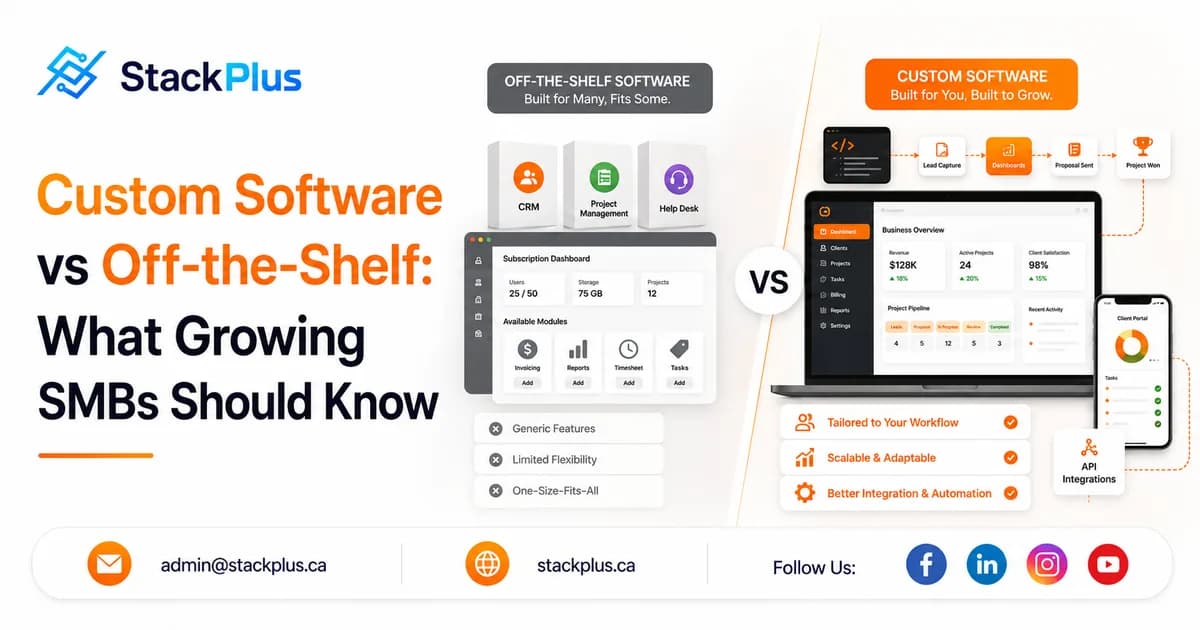
Every growing business eventually hits the same question: should we buy software that already exists, or build something tailored to how we actually operate? The answer is rarely all-or-nothing. The teams that move fastest are the ones that know when a subscription tool is enough, and when custom software becomes the smarter investment.
At StackPlus, we work with SMBs and scale-ups across logistics, healthcare, fintech, e-commerce, and on-demand services. The best outcomes happen when leaders evaluate fit, flexibility, and total cost, not just the monthly license fee on a pricing page.
Table of Contents
When off-the-shelf software is the right fit
Off-the-shelf tools win when your workflow is standard, your team is small, and speed matters more than differentiation. If thousands of companies already run on the same process, a proven SaaS product can get you live in days instead of months.
- Your process closely matches what the product was designed for
- You need basic CRM, accounting, email, or project management fast
- Integrations with your existing stack are straightforward
- The vendor's roadmap covers the features you will need next year
- Your team can adapt their workflow without hurting customer experience
For many early-stage companies, buying first is the correct move. It keeps burn low, validates demand, and buys time to learn what your customers and operations truly require.
When custom software makes more sense
Custom software becomes the better option when your product, operations, or customer experience is the business. If software is how you deliver value, compete, or scale, relying on generic tools often creates friction that shows up in lost revenue, manual workarounds, and slower growth.
- Your workflow is unique and cannot be mapped cleanly to existing tools
- You need deep integrations across multiple internal systems
- Your customer-facing experience is a core differentiator
- Compliance, data ownership, or security requirements are strict
- Spreadsheets and SaaS workarounds are slowing the team down every week
This is common in logistics platforms, healthcare portals, fintech dashboards, marketplaces, and on-demand apps. These businesses rarely win by forcing themselves into someone else's product model.
The hidden cost of forcing tools to fit
The real cost of off-the-shelf software is not always the subscription. It is the operational tax: duplicate data entry, brittle Zapier flows, manual reconciliation, and teams inventing processes around software limitations instead of serving customers.
Over time, that tax compounds. Leaders spend more on licenses, consultants, and internal workarounds than they would have spent on a focused custom build. Worse, the business becomes harder to scale because critical knowledge lives in spreadsheets, inboxes, and one employee's head.
A practical decision framework
Before you commit to buy or build, score the decision across four areas. Be honest about where you are today and where you need to be in 12 to 18 months.
- Workflow fit: How much of your process does the tool support out of the box?
- Competitive advantage: Does the software help you stand out or just keep up?
- Integration load: How many systems must talk to each other reliably?
- Total cost of ownership: Include licenses, implementation, workarounds, and lost time
If two or more areas score poorly against off-the-shelf options, custom software is likely the better long-term investment. If only one area is weak, a hybrid approach may work: buy for standard functions, build for the workflow that defines your business.
How to start a custom build without over-scoping
Custom does not mean building everything at once. Strong projects start with one high-value workflow, clear success metrics, and a roadmap that phases features after real usage data comes in.
- Define the single workflow that creates the most pain or opportunity today
- Identify the minimum user roles and integrations required for v1
- Set measurable outcomes such as time saved, error reduction, or conversion lift
- Plan a 90-day first release instead of a multi-year mega platform
- Leave room to extend the product as operations and demand evolve
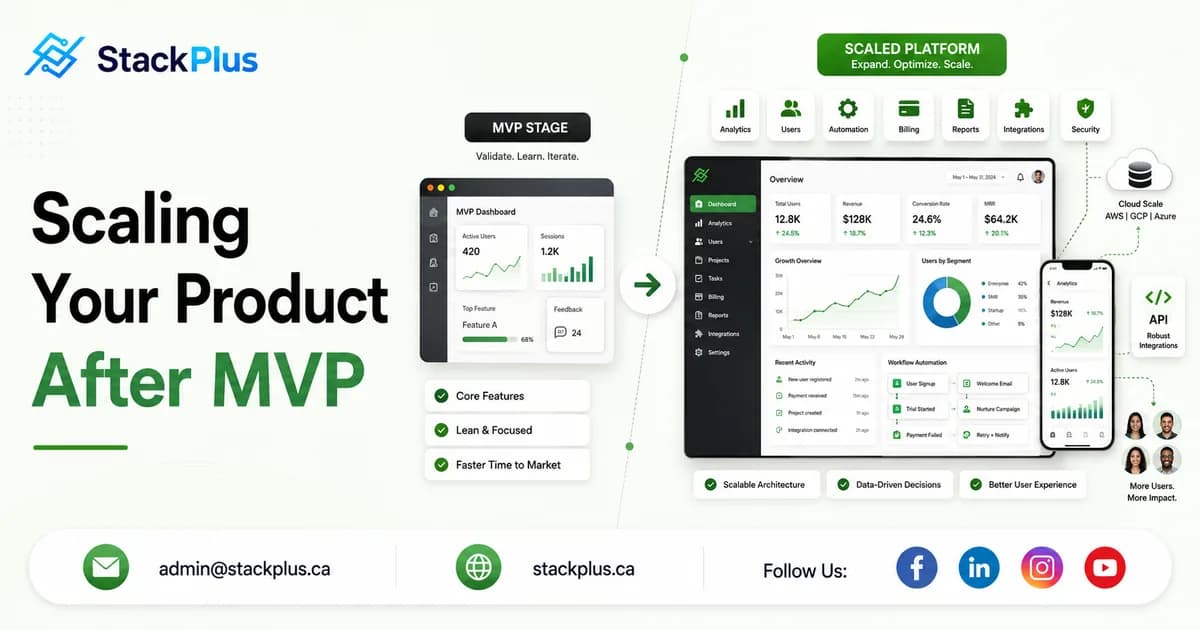
This approach keeps cost predictable while still giving you software that fits how your team works. It is the same philosophy we use when helping clients move from MVP to production-ready platforms.
How StackPlus helps SMBs choose the right path
We help business leaders evaluate buy-vs-build decisions before writing code. When custom software is the answer, StackPlus delivers web apps, mobile apps, internal tools, AI-powered workflows, and dedicated engineering support designed around your operations, not a generic template.
If you are outgrowing spreadsheets, duct-taped SaaS tools, or software that never quite fits, start with a consultation. We will help you map the workflow, estimate a realistic first release, and build a plan that matches your budget and growth goals.
Are you planning an AI-powered MVP?
StackPlus helps startups and growing businesses scope, design, and ship production-ready software with the right AI foundation from day one.