How to Build an MVP with AI in 2026: A Practical Guide for Startups
Published on June 1, 2026
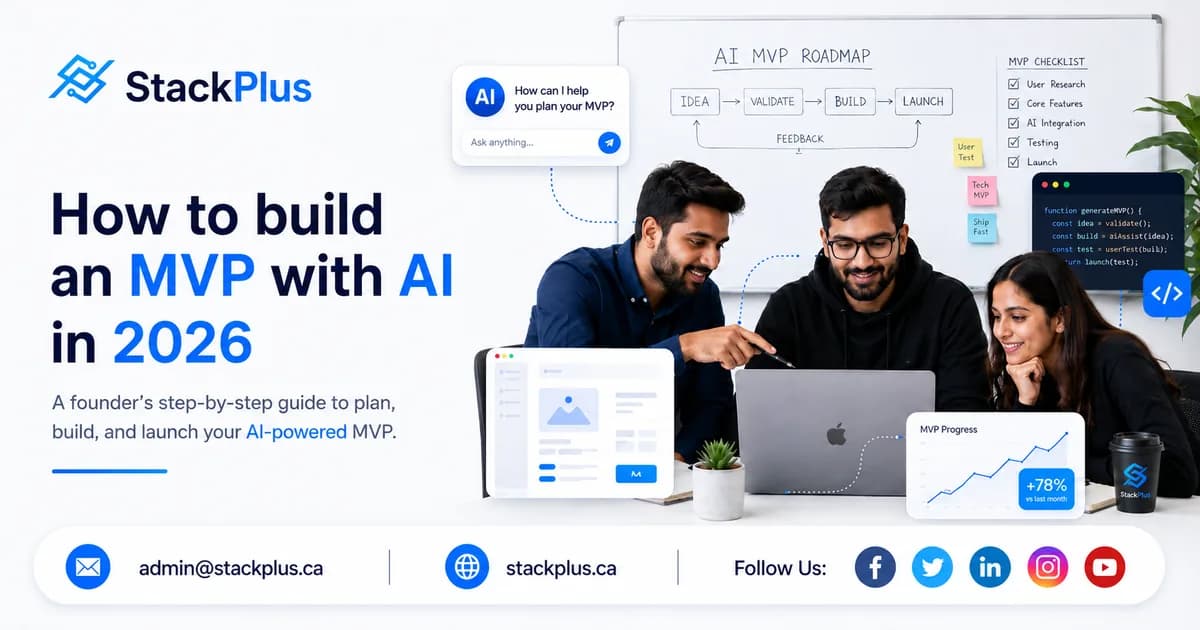
Most startup teams do not fail because they lack AI. They fail because they build too much before learning whether anyone wants the product. In 2026, the teams that win are using AI to reduce time-to-learning, not to inflate scope.
At StackPlus, we work with founders across logistics, healthcare, fintech, on-demand apps, and custom software. The pattern is the same: the best MVPs solve one painful workflow, ship quickly, and collect real usage data before the next sprint.
Table of Contents
Start with the workflow, not the model
Before choosing GPT, Claude, open-source models, or a custom ML pipeline, define the job your user needs done. A strong MVP statement sounds like this: "Help clinic staff summarize intake notes in under 30 seconds" or "Let dispatch managers predict late deliveries before customers call."
If you cannot describe the workflow in one sentence, AI will not save the product. It will only make an unclear idea more expensive.
What belongs in an AI MVP
- One core user role and one primary action
- A simple interface for input, review, and output
- AI-assisted automation where it removes manual work
- A human review step when accuracy matters
- Basic analytics: usage, completion rate, and failure cases
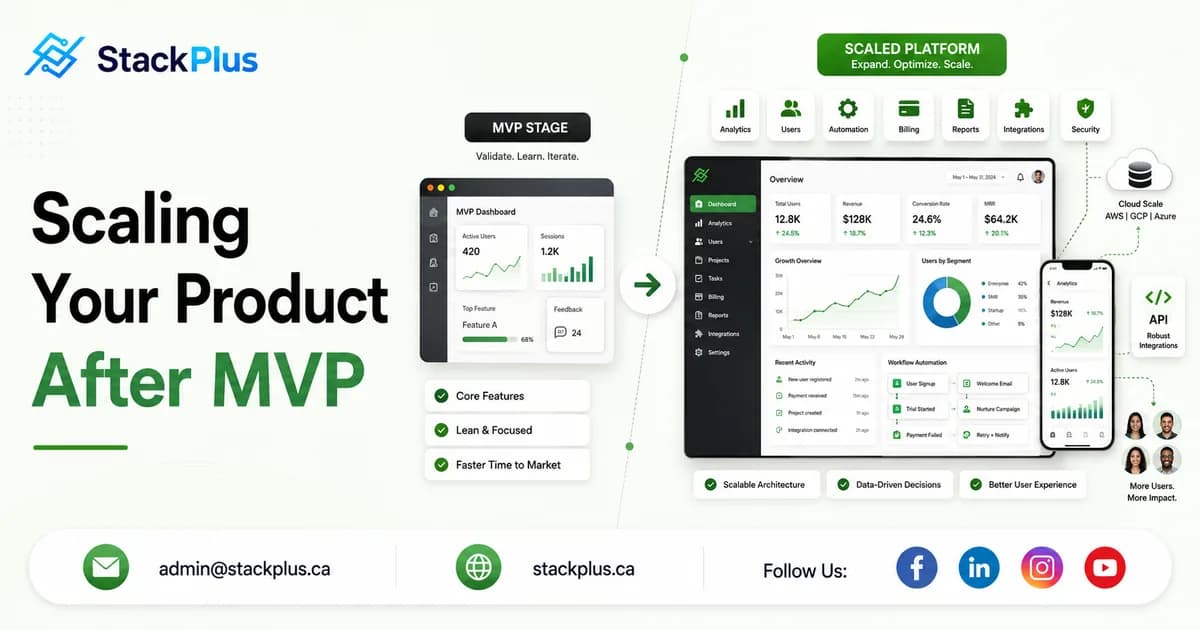
What usually does not belong in v1: multi-tenant admin portals, advanced billing, custom model training, dozens of integrations, and perfect mobile polish on every screen. Those come after validation.
A realistic 90-day build path
For many SMB and startup products, a focused MVP can move from discovery to production in about 90 days when the scope stays disciplined.
- Weeks 1-2: Discovery, user interviews, workflow mapping, and success metrics
- Weeks 3-4: UX flows, technical architecture, and AI approach selection
- Weeks 5-8: Build the core web or mobile experience with one AI feature
- Weeks 9-10: Internal testing, guardrails, and prompt or model tuning
- Weeks 11-12: Pilot launch with a small user group and feedback loop
This timeline works when stakeholders agree on what "done" means for v1. The biggest delays come from adding secondary features too early.
Choose the simplest AI setup that works
You do not always need a custom model on day one. Many strong MVPs begin with retrieval-augmented generation, structured prompts, classification, extraction, or recommendation logic powered by proven APIs and a clean backend.
Use custom ML when you have proprietary data, a repeatable prediction problem, or unit economics that justify model ownership. Until then, optimize for speed, observability, and the ability to swap components later.
Design for trust from the first release
AI products fail in market when users do not understand the output or cannot recover from mistakes. Your MVP should show sources when possible, let users edit AI-generated results, and log every failure for review.
- Explain what the system did in plain language
- Make outputs editable before submission
- Track confidence, latency, and correction rate
- Add role-based access from the start
- Plan for privacy, retention, and customer data boundaries early
How StackPlus helps teams ship AI MVPs
We help startups and growing businesses turn ideas into production-ready software across web, mobile, desktop, and AI-powered workflows. That includes product discovery, UI/UX design, engineering, integrations, and dedicated developer support when your roadmap outpaces your internal team.
If you are planning an AI MVP, start with the workflow you want to improve and the metric that proves it worked. Everything else, model choice, platform, and roadmap, should follow from that.
Ready to scope your first release? Book a consultation with StackPlus and we will help you define a build plan that is ambitious enough to matter and focused enough to ship.
Are you planning an AI-powered MVP?
StackPlus helps startups and growing businesses scope, design, and ship production-ready software with the right AI foundation from day one.