RAG for Internal Ops: How Teams Can Use AI on Their Own Company Knowledge
Published on June 14, 2026
Most growing companies do not have an AI problem. They have a knowledge access problem. Critical information lives across Google Drive folders, Notion pages, PDFs, Slack threads, CRM notes, and the heads of senior employees. When someone needs an answer, they search, ask around, or guess.
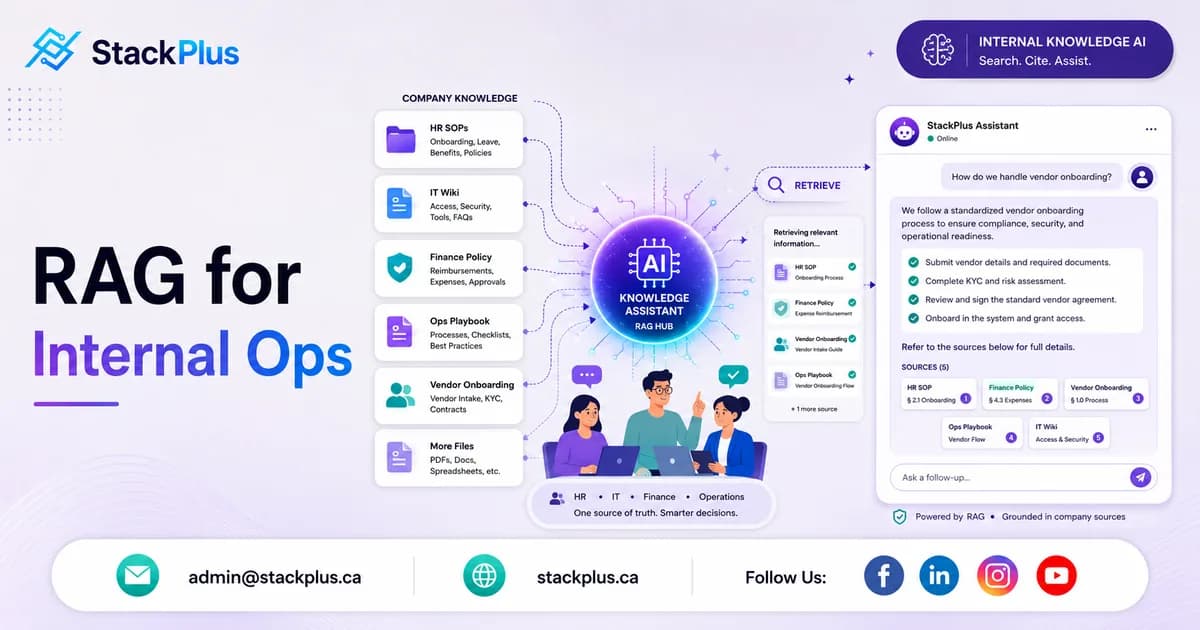
Retrieval-Augmented Generation, or RAG, is one of the most practical ways to fix that. Instead of asking a generic AI model to answer from memory, RAG retrieves relevant content from your internal documents first, then generates a response grounded in that material. For internal operations, that can mean faster onboarding, fewer repeated questions, and more consistent decisions across teams.
Table of Contents
- What RAG means in plain language
- Why internal ops is a strong fit for RAG
- Common internal ops use cases
- RAG vs fine-tuning vs a generic chatbot
- How to implement RAG step by step
- Data quality and security matter more than model choice
- Guardrails that keep internal RAG trustworthy
- How StackPlus builds RAG for internal operations
What RAG means in plain language
RAG combines search with generation. When an employee asks a question, the system finds the most relevant passages from approved internal sources, passes them to an AI model as context, and produces an answer based on that evidence.
That matters because internal ops questions are specific. "What is our refund policy for enterprise clients?" or "How do we escalate a failed deployment?" need answers tied to your actual documentation, not a model's general training data.
Why internal ops is a strong fit for RAG
Internal use cases are often the safest and highest-ROI place to start with AI because the audience is controlled, the documents already exist, and the value is immediate.
- Employees already produce the content RAG needs: SOPs, playbooks, and policy docs
- Answers can be reviewed against source documents for accountability
- Access controls can limit sensitive material by role or department
- Impact is easy to measure: time saved, fewer repeat questions, faster onboarding
- Risk is lower than customer-facing AI because usage stays inside the company
For SMBs and scale-ups, RAG often delivers value faster than building custom models because it uses the knowledge you already have.
Common internal ops use cases
Teams across the business can use the same RAG foundation for different workflows:
- Operations: SOP lookup, process steps, escalation rules, and handoff checklists
- Support: internal troubleshooting guides, product docs, and known-issue playbooks
- Sales: pricing rules, proposal language, objection handling, and case study retrieval
- HR: policy questions, benefits info, leave rules, and onboarding materials
- Engineering: runbooks, architecture notes, release procedures, and incident response docs
- Leadership: reporting definitions, KPI explanations, and operating cadence documents
The best first use case is the one your team already asks repeatedly in Slack or email. That is where RAG creates immediate relief.
RAG vs fine-tuning vs a generic chatbot
Founders often ask whether they should fine-tune a model, buy a chatbot, or build RAG. For most internal ops scenarios, RAG is the best starting point.
- Generic chatbot: fast to try, but answers are not grounded in your documents
- Fine-tuning: useful for style or specialized language, but expensive and harder to update
- RAG: connects live document sources to AI responses and is easier to maintain over time
When policies or procedures change, RAG improves as soon as the underlying documents are updated and re-indexed. That makes it a better fit for operational knowledge that evolves frequently.
How to implement RAG step by step
A practical internal RAG rollout can move quickly when scope stays focused on one department or knowledge base.
- Step 1: Choose one knowledge domain, such as support ops or employee policies
- Step 2: Audit and clean the source documents, removing outdated or duplicate files
- Step 3: Define access rules by role, team, or sensitivity level
- Step 4: Index documents into a searchable vector store or retrieval layer
- Step 5: Connect an LLM that answers only from retrieved context
- Step 6: Show citations or source links with every answer
- Step 7: Pilot with a small team and review wrong answers weekly
Many teams can pilot an internal RAG assistant in four to eight weeks when the document set is well defined and governance is clear from the start.
Data quality and security matter more than model choice
RAG quality depends heavily on the documents you feed it. Messy folders, conflicting SOP versions, and missing ownership will produce messy answers no matter which model you choose.
Security should be designed in from day one. Internal ops data often includes customer details, financial information, HR records, or proprietary process knowledge. Role-based access, audit logs, and clear retention rules are essential.
- Limit each user to documents they are allowed to see
- Exclude draft, archived, or unapproved content from indexing
- Log queries and retrieved sources for review
- Define whether prompts and responses can be stored for improvement
- Use private deployment or approved enterprise AI providers when required
Guardrails that keep internal RAG trustworthy
Employees will only adopt an internal AI assistant if they can trust it. That means designing for transparency and failure gracefully.
- Require source citations on every answer
- Return "I could not find this in approved docs" when confidence is low
- Route sensitive or ambiguous questions to a human owner
- Review edge cases and update docs instead of patching prompts forever
- Train teams on what the assistant is for and what it should not decide alone
How StackPlus builds RAG for internal operations
We help companies embed RAG into internal tools, admin dashboards, support workflows, and custom ops platforms rather than treating it as a standalone chat experiment. That includes document ingestion, retrieval architecture, LLM integration, permissions, and UI design so teams can actually use it in daily work.
If your team is drowning in repeated internal questions, outdated documents, or slow onboarding, RAG may be the highest-leverage AI investment you can make right now. Start with one knowledge base, one user group, and one measurable outcome such as reduced response time or fewer escalations.
Book a consultation with StackPlus and we will help you identify the best internal ops use case, define a secure rollout plan, and build a RAG solution that fits how your company actually works.
Are you planning an AI-powered MVP?
StackPlus helps startups and growing businesses scope, design, and ship production-ready software with the right AI foundation from day one.