How to Build an AI-Powered On-Demand App in 2026: A Founder's Guide
Published on June 12, 2026
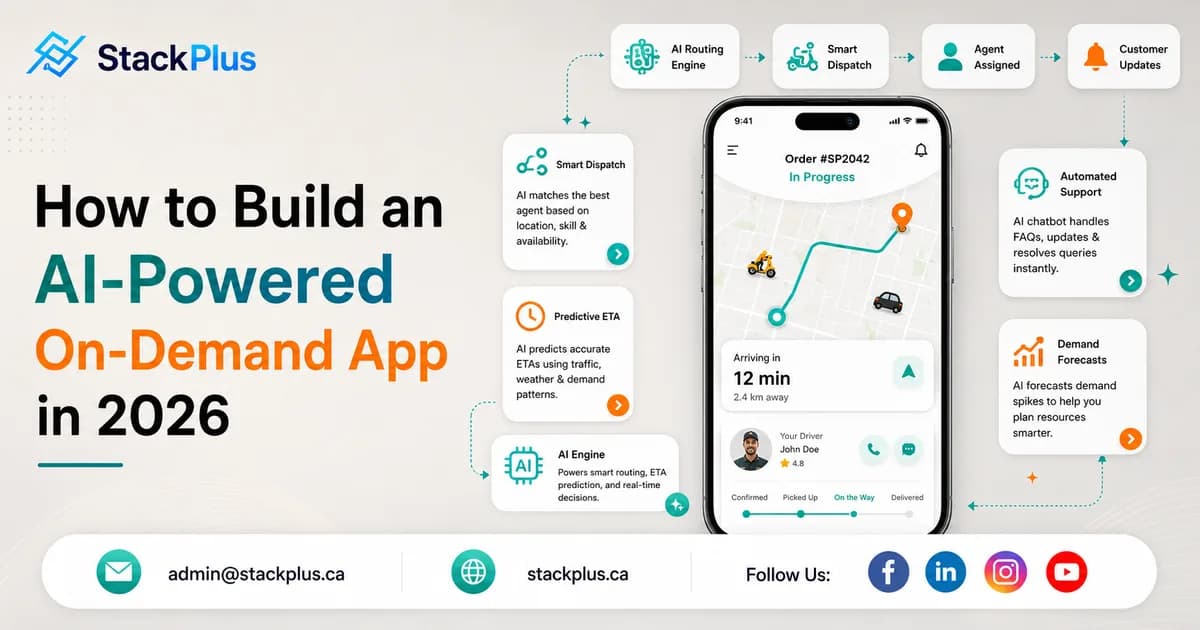
On-demand apps have reshaped how customers book services, order products, and expect real-time fulfillment. In 2026, the bar is even higher. Users want instant status updates, accurate ETAs, fast support, and experiences that feel effortless on mobile. AI is becoming a core part of how strong on-demand products deliver that experience.
But AI is not a substitute for product fundamentals. The best AI-powered on-demand apps still depend on clear workflows, reliable matching logic, and operations your team can trust. At StackPlus, we help founders combine mobile product design with practical AI for dispatch, automation, support, and decision-making.
Table of Contents
- Why AI matters in on-demand products now
- Define your on-demand model first
- The three apps you are really building
- High-value AI use cases for on-demand apps
- What belongs in v1 vs phase two
- Backend and AI architecture basics
- Design guardrails for customer-facing AI
- A realistic launch path for AI on-demand products
- How StackPlus builds AI-powered on-demand apps
Why AI matters in on-demand products now
On-demand businesses generate constant streams of location data, order events, provider availability, customer messages, and exceptions. That makes them a strong fit for AI and automation when applied to specific jobs.
- Smarter matching between demand and available providers
- Better ETA predictions as conditions change
- Automated support triage for common order issues
- Demand forecasting for staffing and pricing decisions
- Fraud and anomaly detection in payments or cancellations
- Assistant-style experiences that help users complete tasks faster
The opportunity is not to slap a chatbot on a generic marketplace template. It is to embed intelligence into the workflows that matter most: request creation, assignment, fulfillment, support, and repeat usage.
Define your on-demand model first
Before choosing AI features, define the business model your app supports. AI should reinforce the model, not distract from it.
- Instant matching: users expect service as soon as possible
- Scheduled booking: users choose a time slot in advance
- Marketplace: multiple providers compete for the same request
- Managed fulfillment: your team controls quality and delivery
- Hybrid: some services on-demand, others scheduled or quote-based
Instant courier apps may prioritize AI-assisted dispatch and route optimization. Scheduled home services may prioritize slot prediction and provider utilization. The model determines which AI features create real value.
The three apps you are really building
Most on-demand platforms need three connected experiences. AI can improve each one when scoped carefully.
- Customer app: request services, pay, track progress, get support, and reorder
- Provider app: accept jobs, update status, navigate workflow, and manage earnings
- Admin dashboard: monitor operations, resolve exceptions, and control the network
AI can help customers find the right service faster, help providers prioritize the next best job, and help admins spot issues before they become complaints. Start with one role and one workflow rather than trying to automate everything at launch.
High-value AI use cases for on-demand apps
These are the AI capabilities we most often explore with founders building on-demand products:
- Intelligent dispatch: recommend the best provider based on distance, rating, workload, and history
- Dynamic ETA updates: adjust arrival predictions using live signals and past performance
- Support agents: classify issues, draft responses, and route tickets to the right team
- Demand forecasting: predict peak periods by zone, service type, or season
- Personalized reordering: suggest repeat services based on user behavior
- Operational alerts: flag unusual cancellation patterns, fraud signals, or SLA risks
The strongest first AI feature is usually internal: help operations run better before exposing automation directly to customers.
What belongs in v1 vs phase two
Founders often want AI everywhere on day one. A better approach is to launch a dependable on-demand core, then layer intelligence once real usage data exists.
- V1 core: signup, service request, payment, tracking, provider workflow, admin controls
- V1 AI (optional): support triage, basic recommendations, or dispatch assist with human review
- Phase two: smarter matching, ETA modeling, fraud detection, and personalized retention flows
- Phase three: broader automation, multi-city optimization, and deeper predictive operations
This phased approach reduces risk and gives your team measurable data before scaling AI across the product.
Backend and AI architecture basics
AI-powered on-demand apps still depend on strong backend foundations: order state machines, location events, provider availability, payment flows, and exception handling. AI layers work best when they sit on top of clean event data and reliable business rules.
Important architecture questions include: Which events should trigger automation? Where does a human need to approve an AI decision? How will you log prompts, outputs, and overrides? Can the system fall back safely when AI confidence is low?
For many products, the right stack combines custom backend logic, real-time notifications, mobile apps, and LLM or ML services for classification, summarization, ranking, or prediction.
Design guardrails for customer-facing AI
When AI touches customers or providers directly, trust becomes part of the product. Users should understand what the system is doing and be able to recover quickly when it is wrong.
- Keep humans in the loop for refunds, disputes, and edge cases
- Show clear order status even when AI is assisting behind the scenes
- Do not let AI send external messages without approval in early releases
- Log every automated decision that affects pricing, assignment, or cancellation
- Test failure scenarios such as no provider availability or bad location data
A realistic launch path for AI on-demand products
A focused on-demand MVP with one practical AI workflow can often launch in 12 to 16 weeks when scope stays disciplined.
- Weeks 1-2: Define business model, user roles, and the first AI use case
- Weeks 3-4: Design customer, provider, and admin flows with automation points
- Weeks 5-10: Build core mobile/web experiences and backend order logic
- Weeks 11-12: Add one AI workflow, payments, notifications, and pilot testing
- Weeks 13-16: Improve matching, support, and reliability before wider rollout
Pilot in one geography with one service category first. That gives you the operational data needed to make AI genuinely useful instead of decorative.
How StackPlus builds AI-powered on-demand apps
StackPlus helps founders build custom on-demand platforms that combine mobile apps, backend systems, and practical AI. We design the product around real operations, then add intelligence where it improves speed, cost, or customer experience.
If you are planning an AI-powered on-demand app, start with the workflow that defines your business: matching, fulfillment, support, or retention. We can help you scope v1, choose the right AI features, and build a platform that is ready for real users.
Are you planning an AI-powered MVP?
StackPlus helps startups and growing businesses scope, design, and ship production-ready software with the right AI foundation from day one.